
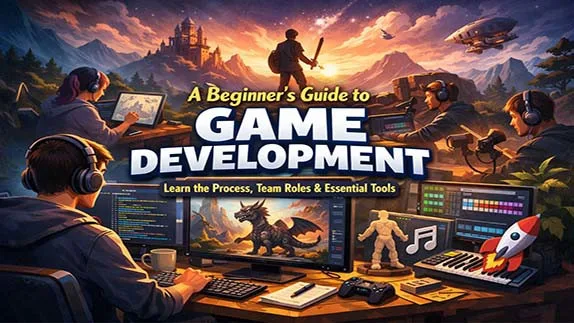
A beginner's guide to game development. Learn the process, team roles, and essential tools in simple terms. start your game creation journey today!
The Exciting World of Game Development: A Beginner's Guide
- 👨🏫 Author: mohammad saleh salmanzadeh
- 🌐 Language: Persian / English
- 📝 Creation Date:
- 📅 Last Updated Date:
- 📂 Category: Game Development Training
- 🔗 Sharing:

The Exciting World of Game Development: A Beginner's Guide
Introduction to Game Development
Hello and welcome! Have you ever played a video game and wondered, "How was this incredible world created?" Game development is the magical process behind every video game you've ever enjoyed. It's a fascinating blend of creativity, technology, and storytelling that brings imaginary worlds to life. Whether it's a simple mobile puzzle game or an expansive adventure with stunning graphics, all games start with an idea and a team of passionate creators. In this article, we'll explore the journey from concept to controller, breaking down the process into understandable steps. You'll discover that game development isn't just for programming geniuses—it's a multidisciplinary art that welcomes artists, writers, musicians, and dreamers of all kinds.
The Core Elements of a Video Game
Before we dive into how games are made, let's understand what makes a game. Think of a game as a delicious pizza with several key ingredients.
Gameplay: The Foundation
Gameplay is the most essential ingredient—the dough of our pizza. It answers the question: "What does the player actually DO?" It includes the rules, the challenges, and the actions a player can take. Is it a jumping puzzle, a strategic battle, or a peaceful exploration? Good gameplay feels responsive, fair, and fun. It's the core interactive experience that keeps players engaged.
Story and Characters: The Flavor
While not all games have a complex story (think of Tetris!), many use narrative to create emotional connection—this is the sauce and toppings. Characters, dialogue, and plot give context to the gameplay. Why is the hero fighting these enemies? What mystery needs solving? A compelling story can transform simple tasks into memorable adventures.
Art and Visuals: The Presentation
This is how the game looks—the cheese and vibrant toppings. Visual art includes character designs, environments, animations, and user interfaces. The art style sets the tone, whether it's cute and cartoony, dark and realistic, or something abstract and unique. Great visuals create a believable and immersive world for players to get lost in.
Sound and Music: The Atmosphere
Often underestimated, sound completes the experience—the enticing aroma of the pizza. Sound effects make actions feel powerful and real (think of a satisfying "click" or a dramatic explosion). Music sets the emotional mood, building tension during a boss fight or providing calm during exploration. Good audio design makes the virtual world feel alive.
The Game Development Team: Who Creates a Game?
Game development is rarely a solo endeavor. It's a collaborative symphony of different specialists, especially in larger projects. Let's meet the key players.
Designers: The Visionaries
Game Designers: They are the chief architects. They design the rules, levels, challenges, and overall player experience. They write the initial design documents that become the game's blueprint.
Level Designers: These are the environment builders. They take the game's rules and create specific, fun-to-play stages or worlds using the game's engine and assets.
Programmers: The Engineers
Gameplay Programmers: They write the code that makes the rules and mechanics actually work. If a designer says "the player can double-jump," the programmer makes that happen in the game.
AI (Artificial Intelligence) Programmers: They code the behavior of non-player characters (NPCs), making enemies smart and allies helpful.
Engine/Graphics Programmers: They work on the core technology, making the game run smoothly and look beautiful.
Artists: The Visual Storytellers
Concept Artists: They create the initial paintings and sketches that define the game's visual style.
2D/3D Artists: They build the actual game assets. 3D modelers create characters and objects, while texture artists paint surfaces to make them look like metal, skin, or stone.
Animators: They bring characters and objects to life, creating walks, runs, attacks, and facial expressions.
Other Essential Roles
Writers: Craft the story, dialogue, and in-game text.
Sound Designers & Composers: Create every sound effect and compose the musical score.
Producers: Project managers who keep the team on schedule and on budget.
Quality Assurance (QA) Testers: The unsung heroes who play the game relentlessly to find and report bugs before release.
The Game Development Process: From Idea to Launch
Creating a game is a marathon, not a sprint. It follows a structured, though often iterative, process.
Phase 1: Concept and Pre-production (The Blueprint)
This is the planning stage. The team brainstorms the core idea, defines the game's genre, target audience, and unique selling points. They create concept art, write preliminary design documents, and build simple prototypes to test if the core gameplay is fun. A small vertical slice—a polished, playable sample of the final game—is often made to secure funding or greenlight the full project.
Phase 2: Production (The Heavy Lifting)
This is the longest phase, where the bulk of the game is built.
Content Creation: Artists create assets, programmers write thousands of lines of code, level designers build worlds, and writers draft the story.
Integration: All these pieces are put together into the game engine. The level becomes playable, characters can move through it, and sounds are attached to actions.
Iteration: The team constantly tests and refines. Levels might be redesigned for better flow, character speed might be adjusted, and story beats might be rewritten.
Phase 3: Testing and Polishing (The Refinement)
As features are completed, QA testers systematically play every part of the game. They look for bugs—from game-crashes to minor graphical glitches. The team fixes these issues and focuses on "polish": making controls feel perfect, balancing difficulty, improving animations, and optimizing performance so the game runs well on its target platform (PC, console, mobile).
Phase 4: Launch and Post-Launch (The Release & Beyond)
The game is finalized, packaged, and released to the public (on Steam, app stores, consoles, etc.). But the work often continues!
Day-One Patches: Critical fixes for issues found right after launch.
Updates and DLC: Developers may release new content, features, or story expansions.
Community Support: Teams often engage with players, gather feedback, and fix any lingering issues.
Tools of the Trade: Game Engines and Software
Developers use specialized software, and the most important tool is the Game Engine. Think of it as a powerful, pre-built workshop for making games. It handles complex tasks like rendering graphics, playing sounds, and simulating physics, so developers can focus on their unique game.
Unity: Extremely popular for 2D, 3D, and mobile games. Known for its user-friendly interface and large learning community. Great for beginners.
Unreal Engine: Renowned for its cutting-edge, high-quality 3D graphics. Powers many AAA (big-budget) games. It uses a visual scripting system called Blueprints, which is more accessible for non-programmers.
Godot: A free, open-source engine that's gaining rapid popularity. It's lightweight, flexible, and excellent for 2D games.
Other Software: Artists use tools like Blender (3D modeling), Photoshop (2D art), and Aseprite (pixel art). Programmers use code editors like Visual Studio. Sound designers use Audacity or FMOD.
How to Start Your Game Development Journey
Interested in making your own game? The good news is, it's more accessible than ever!
Start Small: Your first game should be tiny. Recreate a simple classic like Pong or a basic platformer. Finishing a small project is more valuable than getting lost in a massive, unfinished dream game.
Choose a Beginner-Friendly Engine: Download Unity or Godot. They have vast free resources and tutorials.
Embrace Tutorials: Platforms like YouTube, Udemy, and the official engine documentation are goldmines. Follow step-by-step tutorials to learn the basics.
Learn the Basics of Programming: Even visual scripting requires logical thinking. For text-based coding, C# (used in Unity) is a great starting language. Take it one concept at a time.
Join the Community: Connect with other learners on forums like Reddit's r/gamedev. Sharing struggles and successes is incredibly motivating.
Conclusion: Your Adventure Awaits
Game development is a challenging but immensely rewarding field. It's a unique intersection where technology meets art, logic dances with creativity, and solitary focus blends with intense teamwork. From the initial spark of an idea to the final lines of code and the last brushstroke of art, creating a game is a journey of building entire worlds from imagination.
Remember, every sprawling epic like The Legend of Zelda or Elden Ring began with the same basic building blocks we've discussed: a simple gameplay loop, a dedicated team, and a structured process. The tools are now at your fingertips, and the global community of developers is more welcoming and resource-rich than ever. So, whether you dream of telling a heartfelt story, designing the next addictive puzzle mechanic, or simply bringing a strange character from your sketchbook to life, there's a place for you in game development. Start small, be persistent, and most importantly, have fun creating. Your journey from player to creator begins now. What world will you build?
📚 Related Articles:
- Computer Game Development Tutorial: Complete Guide for Beginners
- Game Engines Explained Simply: A Guide for Beginners
- Complete Game Development Learning Path (From Zero to Real Skill)
- Game Character Design: Complete Beginner's Guide to Creating Memorable Characters
- Game Content Creation: Complete Guide for Beginners
- Game Programming from Scratch: A Simple Guide for Beginners
Q1: What is game development and what are its main components?
Answer: Game development is the process of creating a video game from concept to final product. It involves several key components: Gameplay (mechanics and rules), Story and Characters (narrative and relationships), Art and Visuals (character and environment design, animation), and Sound and Music (sound effects and soundtrack). All these components are created through collaboration among a team of specialists.
Q2: Who are the key members of a game development team?
Answer: A game development team typically includes Game Designers (architects and level designers), Programmers (gameplay, AI, and engine developers), Artists (concept, 2D, 3D, and animators), Writers, Sound Designers and Composers, Producers (project managers), and Quality Assurance Testers (bug finders). Each role requires specific skills and expertise.
Q3: What are the stages of making a video game?
Answer: The process usually involves four main stages: Concept and Pre-production (ideation, planning, and prototyping), Production (main development including coding, art, and content creation), Testing and Polishing (bug fixing, optimization, and balancing), and Release and Post-release (launching the game, updates, and community support). These stages are often iterative.
Q4: What is the best game engine for beginners?
Answer: For beginners, Unity is an excellent choice due to its user-friendly interface, large community, and extensive learning resources. Godot is also a great free and open-source option, especially for 2D games. Unreal Engine offers stunning graphics but has a steeper learning curve and is better suited for professional projects. The choice depends on your goals and interests.
Q5: Do I need programming skills to start game development?
Answer: No, programming skills are not strictly required, as engines like Unity and Unreal support visual scripting (like Bolt and Blueprints) that allow you to build game logic without writing code. However, learning basic programming concepts like variables, conditionals, and loops will give you more control and be very helpful for your professional journey.
Q6: How can I start making my first game?
Answer: Follow these steps to start: (1) Start small – recreate a simple game like Pong or a basic platformer. (2) Choose a beginner-friendly engine – download Unity or Godot. (3) Follow tutorials – use step-by-step guides on YouTube and official documentation. (4) Learn programming basics – get familiar with fundamental concepts. (5) Join the community – participate in forums and developer groups to learn from others. Completing a small project is more valuable than starting a large unfinished one.
- 🗨️ No comments have been posted for this article yet. Be the first!