
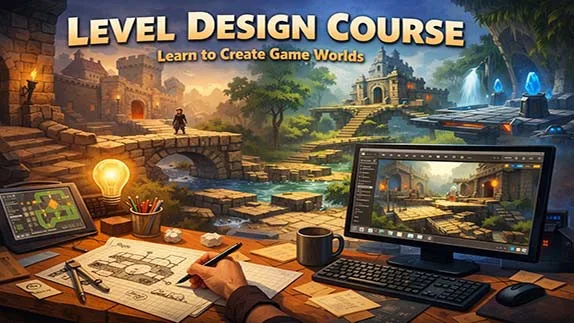
This Level Design course is a beginner-friendly guide to designing game levels from scratch, focusing on player experience without requiring coding or prior knowledge
Level Design Course: A Complete Beginner’s Guide to Designing Game Worlds
- 👨🏫 Author: mohammad saleh salmanzadeh
- 🌐 Language: Persian / English
- 📝 Creation Date:
- 📅 Last Updated Date:
- 📂 Category: Game Design
- 🔗 Sharing:

Level Design Course: A Complete Beginner’s Guide to Designing Game Worlds
Video games are more than graphics and mechanics. What truly shapes a player’s experience is how the world is designed—where they go, what they see, and how they interact with the environment. This is the role of level design.
If you have ever wondered why some games feel intuitive, exciting, and immersive while others feel confusing or boring, the answer often lies in level design. In this article, I will explain what a Level Design Course is, what you will learn in it, and why it is one of the most important skills in game development.
This guide is written for absolute beginners. You do not need any technical background to understand it.
What Is Level Design?
Level design is the art and science of creating playable spaces in a game.
A level designer decides:
Where the player starts
Where the player can go
What obstacles exist
How challenges are introduced
How the environment guides the player without instructions
In simple terms, level design is about shaping player experience through space.
A “level” can be:
A room
A map
A dungeon
An open world area
Even a short tutorial section
What Is a Level Design Course?
A Level Design Course teaches you how to design game levels that are:
Fun
Clear
Balanced
Engaging
Player-friendly
The course focuses on thinking like a designer, not just learning software.
You learn:
Why certain designs work
Why others fail
How players think and move
How to guide players without telling them what to do
A good level design course is about decision-making, not decoration.
Who Is a Level Design Course For?
Beginners With No Experience
You do not need:
Programming knowledge
Art skills
Game development experience
The course starts from basic concepts and builds step by step.
Aspiring Game Designers
If you want to work in:
Game studios
Indie game development
Interactive media
Level design is one of the most common entry roles.
Hobbyists and Creators
Even if you are:
Making small games
Modding existing games
Designing maps for fun
A level design course will dramatically improve your results.
What You Will Learn in a Level Design Course
Core Principles of Level Design
You will learn the foundations that apply to all games, regardless of genre.
These include:
Player guidance
Risk and reward
Pacing
Flow
Difficulty progression
These principles are more important than tools.
Understanding Player Psychology
A major part of level design is predicting player behavior.
You learn:
How players read environments
How color, light, and shape guide attention
Why players miss obvious paths
How confusion happens
Good level designers design for human behavior, not for themselves.
Game Flow and Pacing
Flow is how smoothly a player moves through a level.
You learn how to:
Alternate between calm and tension
Avoid boredom and frustration
Control speed without forcing it
Create memorable moments
Bad pacing ruins good ideas. A level design course fixes that.
Designing for Different Game Genres
Level design changes depending on the game type.
You will study examples from:
Platformers
Action games
Puzzle games
Open-world games
Horror games
Each genre has different design rules, and the course explains why.
Tools Used in Level Design Courses
Game Engines (Beginner-Friendly)
Most courses use engines like:
Unity
Unreal Engine
Do not worry—coding is minimal or optional at beginner level.
The focus is on:
Layout
Player movement
Interaction
Testing
Paper and Blockout Design
Surprisingly, many courses start without computers.
You may design levels using:
Paper sketches
Simple shapes
Gray boxes (blockouts)
This teaches you to focus on structure before visuals.
Level Design Process Explained Simply
Step 1: Define the Player Goal
Every level answers one question:
What should the player achieve here?
Without a clear goal, the level fails.
Step 2: Create the Main Path
This is the primary route the player follows.
You learn to:
Make it readable
Make it inviting
Avoid confusion
Players should move forward naturally.
Step 3: Add Challenges and Choices
Obstacles create engagement.
These can include:
Enemies
Puzzles
Environmental hazards
Timing challenges
A level design course teaches how much is enough.
Step 4: Guide Without Instructions
Great level design does not rely on arrows or text.
You learn to guide players using:
Lighting
Landmarks
Contrast
Sound
Level geometry
If players feel smart, the design is working.
Step 5: Playtesting and Iteration
This is where beginners usually fail—but courses fix that.
You learn to:
Observe players
Identify confusion
Accept criticism
Improve layouts
Level design is iterative, not perfect on the first try.
Common Mistakes a Level Design Course Helps You Avoid
Overdesigning
More content does not mean better design.
Courses teach restraint.
Designing for Yourself
Beginners assume players think like them.
They do not.
Courses train you to design for real players.
Ignoring Scale and Movement
Spaces that are too large or too small break immersion.
Courses teach correct proportions.
Poor Difficulty Curves
Sudden spikes frustrate players.
Level design courses teach progressive challenge.
Career Benefits of Learning Level Design
Entry-Level Game Industry Role
Level design is one of the most accessible roles for beginners.
Many designers start here.
Transferable Skills
Level design teaches:
Systems thinking
User experience (UX)
Problem-solving
Spatial reasoning
These skills apply beyond games.
Strong Portfolio Opportunities
Courses often guide you to create:
Playable levels
Documented design decisions
Clear portfolios
Studios value proof of thinking, not certificates.
How to Choose the Right Level Design Course
Look for courses that:
Focus on fundamentals, not just tools
Include real examples
Emphasize playtesting
Encourage iteration
Explain why, not just how
Avoid courses that:
Only teach engine buttons
Skip design theory
Promise “fast success”
Level design is a craft, not a shortcut.
Conclusion: Is a Level Design Course Worth It?
Yes—if you want to understand how games actually work.
A level design course teaches you:
How players think
How space creates emotion
How invisible decisions shape experience
You do not need talent.
You do not need coding.
You do not need expensive tools.
You need structured thinking, practice, and feedback.
Level design is where creativity meets logic.
If you master it, you stop guessing—and start designing with intent.
Want to learn level design hands-on and build your own game levels like a pro? With the “Complete Indie Game Development Process” course, get real experience creating games with engines like Unity — enroll now and step into the world of game design!
📚 Related content:
- The Complete Learning Path to Becoming a Game Developer (From Zero to Real Skills)
- The Best Game Engine for Beginners: A Complete Guide
- Learning Game Programming from Scratch: A Beginner-Friendly Guide
Question 1:
What is Level Design?
Answer:
Level Design is the process of creating playable spaces and environments in a video game. A level designer decides where players start, how they move through the environment, what challenges they face, and how the experience is structured.
Question 2:
Do I need programming skills to learn Level Design?
Answer:
No. Beginners do not need programming knowledge or advanced artistic skills to start learning Level Design. The main focus is understanding player experience, level structure, game flow, and problem-solving.
Question 3:
What do you learn in a Level Design course?
Answer:
A Level Design course teaches important concepts such as player guidance, path design, game pacing, flow, difficulty progression, blockout creation, playtesting, and improving level layouts.
Question 4:
How is Level Design related to Unity and Unreal Engine?
Answer:
Many level designers use game engines like Unity and Unreal Engine to create and test game environments. These tools help designers build spaces, evaluate player movement, and refine gameplay experiences.
Question 5:
Is learning Level Design useful for a career in game development?
Answer:
Yes. Level Design is one of the accessible career paths in game development. It helps you develop skills such as systems thinking, user experience design, problem-solving, and player-focused design. Building playable levels can also help you create a strong portfolio.
- 🗨️ No comments have been posted for this article yet. Be the first!