
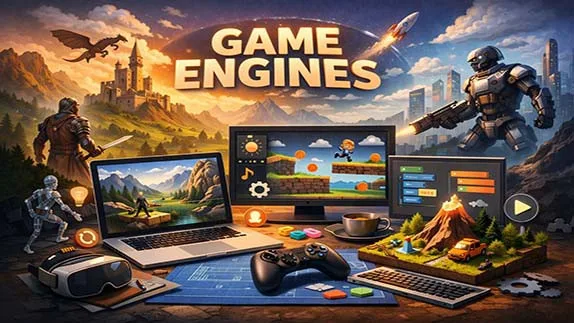
An easy introduction to game engines, covering core concepts and popular engines like Unity, Unreal Engine, and Godot
Game Engines Explained: A Beginner’s Guide to How Games Are Made
- 👨🏫 Author: mohammad saleh salmanzadeh
- 🌐 Language: Persian / English
- 📝 Creation Date:
- 📅 Last Updated Date:
- 📂 Category: Game Engines
- 🔗 Sharing:

Game Engines Explained: A Beginner’s Guide to How Games Are Made
Video games are everywhere today—on phones, computers, consoles, and even in browsers. But have you ever wondered how games are actually created? Behind every game, from simple mobile puzzles to massive open-world adventures, there is a powerful tool called a game engine.
This article explains game engines in a clear, simple, and non-technical way. You do not need any programming or game development background to understand it. By the end, you will know what game engines are, why they matter, and which ones beginners usually start with.
What Is a Game Engine?
A game engine is a software framework that developers use to build video games. Instead of creating everything from scratch, a game engine provides ready-made tools that handle the most difficult parts of game development.
In simple terms:
A game engine is the “engine” that makes a game work—just like a car engine makes a car move.
Without game engines, developers would need to write extremely complex code for graphics, sound, physics, and controls every single time they make a game.
Why Game Engines Exist
Creating a game involves many different systems working together at the same time. Game engines exist to save time, reduce complexity, and standardize development.
Problems Without a Game Engine
Without a game engine, developers would need to:
Build a graphics system from zero
Handle keyboard, mouse, controller, or touch input manually
Create physics systems (gravity, collisions, movement)
Manage sound, music, and animations
Optimize performance for different devices
This would take years for even a simple game.
What a Game Engine Solves
A game engine:
Combines all these systems into one platform
Lets developers focus on game ideas and design, not low-level technical details
Makes game development accessible to small teams and even solo creators
Core Components of a Game Engine
Every game engine includes several core components. You do not need to master them, but understanding what they do is important.
Graphics Rendering
This component displays everything you see on the screen:
Characters
Environments
Lighting and shadows
Visual effects
Modern engines support both 2D and 3D graphics.
Physics System
The physics system simulates real-world behavior, such as:
Gravity
Collisions
Falling objects
Jumping and movement
Thanks to physics engines, developers do not need to calculate these behaviors manually.
Audio System
This handles:
Sound effects
Background music
Voice lines
It also controls volume, distance effects, and directional sound.
Input Handling
Input systems allow players to control the game using:
Keyboard and mouse
Game controllers
Touch screens
The engine translates player actions into in-game behavior.
Scripting and Logic
This is where game behavior is defined:
What happens when a player jumps
How enemies react
Game rules and scoring
Most engines use simple scripting languages or visual tools for this.
Types of Game Engines
Not all game engines are the same. They can be grouped based on how they are used.
General-Purpose Game Engines
These engines can be used to create many types of games.
Examples:
Action games
Puzzle games
Mobile games
Virtual reality experiences
They are flexible and widely used.
Specialized Game Engines
Some engines are designed for specific purposes, such as:
2D games only
Educational simulations
Visual storytelling
These engines are often simpler but less flexible.
Popular Game Engines for Beginners
If you are new to game development, choosing the right engine matters. Below are the most popular beginner-friendly game engines.
Unity
What Is Unity?
Unity is one of the most widely used game engines in the world. It supports both 2D and 3D games and works on many platforms.
Why Beginners Choose Unity
Easy to learn
Huge community and tutorials
Works for mobile, PC, console, and VR
Uses simple scripting (C#)
Unity is often recommended as a first game engine.
Unreal Engine
What Is Unreal Engine?
Unreal Engine is a powerful game engine known for high-quality graphics.
Key Features
Stunning visuals
Visual scripting system called Blueprints
Used in professional AAA games
Is It Beginner-Friendly?
Yes, but it has a steeper learning curve than Unity. It is ideal for learners interested in realistic graphics.
Godot
What Is Godot?
Godot is an open-source game engine that is completely free.
Why It Is Growing in Popularity
Lightweight and fast
Easy scripting language
Great for 2D games
No licensing fees
Godot is an excellent choice for beginners who prefer open-source tools.
GameMaker
What Is GameMaker?
GameMaker is designed mainly for 2D games.
Beginner Advantages
Drag-and-drop features
Minimal coding required
Ideal for simple games
It is commonly used for indie and educational projects.
Game Engines and Programming: Do You Need to Code?
This is one of the most common questions beginners ask.
The Short Answer
No, not always—but learning basic coding helps a lot.
Visual Scripting
Some engines allow developers to:
Create logic using visual blocks
Avoid writing code at first
This is great for beginners.
Why Coding Still Matters
Even basic scripting allows you to:
Customize gameplay
Fix bugs
Understand how games really work
Most beginners eventually learn simple programming concepts over time.
Game Engines Beyond Entertainment
Game engines are no longer used only for games.
Other Uses of Game Engines
Educational simulations
Architecture and virtual tours
Medical training
Film and animation
Virtual reality experiences
This makes learning game engines a valuable skill beyond gaming.
Choosing the Right Game Engine
There is no “best” game engine for everyone.
Ask Yourself These Questions
Do I want to make 2D or 3D games?
Am I interested in mobile or PC games?
Do I prefer visual tools or coding?
Do I want free and open-source software?
Your answers will guide your choice.
Common Beginner Mistakes
Many beginners fail not because engines are hard, but because of poor expectations.
Typical Mistakes
Trying to build a large game immediately
Switching engines too often
Ignoring tutorials and documentation
Expecting instant results
Game development is a learning process, not a shortcut to success.
The Learning Curve: What to Expect
Game engines may feel overwhelming at first. This is normal.
What Happens Over Time
First week: confusion
First month: small wins
After several months: confidence
Consistency matters more than talent.
Conclusion: Why Game Engines Matter
Game engines are the foundation of modern game development. They make it possible for beginners, small teams, and independent creators to turn ideas into playable experiences.
You do not need advanced technical knowledge to start. With the right engine, patience, and practice, anyone can learn the basics of game creation.
The most important step is simple:
Choose one engine, start small, and keep learning.
Game engines are not just tools—they are gateways into creativity, problem-solving, and digital storytelling.
Want a beginner-friendly way to understand game engines and see how real games are built with Unity in practice? Check out the “Complete Indie Game Development Process” course and experience the real workflow of making a game.
📚 Related content:
- The Best Game Engine for Beginners: A Complete Guide
- Learning Unreal Engine: A Beginner-Friendly Guide to Game Development and Real-Time Creation
- Unity Training: A Complete Beginner’s Guide to Game Development
- Learning GameMaker: A Beginner-Friendly Guide to Game Development
- Learning Game Programming from Scratch: A Beginner-Friendly Guide
Question 1
What is a game engine?
Answer
A game engine is a software framework that provides developers with the tools needed to build video games. It includes systems for graphics rendering, physics, audio, input handling, scripting, and many other features that simplify game development.
Question 2
Which game engine is best for beginners?
Answer
The best game engine depends on your goals. Unity is an excellent all-around choice, Godot is great for open-source projects, GameMaker is ideal for 2D games, and Unreal Engine is suitable for high-end graphics and advanced projects.
Question 3
Do I need programming skills to use a game engine?
Answer
No. Many modern game engines offer visual scripting or drag-and-drop tools that allow beginners to start creating games without programming. However, learning basic programming concepts will help you create more advanced projects.
Question 4
What does a game engine do?
Answer
A game engine handles graphics rendering, physics simulation, audio, user input, scripting, animation, and deployment to different platforms, allowing developers to focus on designing and building their games.
Question 5
Are game engines only used for making games?
Answer
No. Game engines are also widely used in virtual reality (VR), augmented reality (AR), architecture, education, simulations, filmmaking, animation, and interactive visualization.
- 🗨️ No comments have been posted for this article yet. Be the first!