A beginner-friendly guide to game content creation, covering core concepts, content types, tools, workflows, and player-focused design principles
Game Content Creation: A Beginner’s Guide to Making Engaging Game Experiences
- 👨🏫 Author: mohammad saleh salmanzadeh
- 🌐 Language: Persian / English
- 📝 Creation Date:
- 📅 Last Updated Date:
- 📂 Category: Game Content Creation
- 🔗 Sharing:

Game Content Creation: A Beginner’s Guide to Making Engaging Game Experiences
Game content creation is one of the most important parts of modern video game development. No matter how powerful a game engine is, without good content, the game will feel empty, boring, or repetitive. This article explains what game content creation is, why it matters, and how beginners can start learning it step by step.
What Is Game Content Creation?
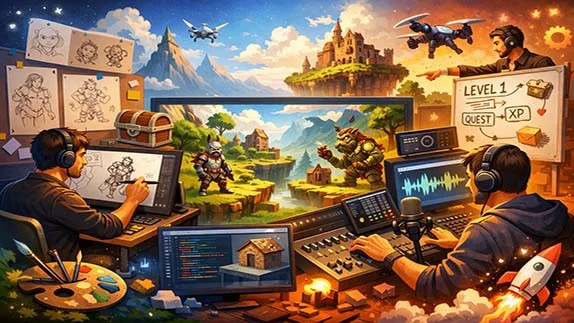
Game content creation is the process of designing and producing everything a player sees, hears, and interacts with inside a game. This includes visuals, sounds, stories, characters, levels, and gameplay elements.
In simple terms:
The engine is the machine.
The content is what gives the game life.
Without content, a game engine is just a technical shell.
Why Game Content Creation Is So Important
A game succeeds or fails mainly because of its content. Players do not play games for code or algorithms—they play for experiences.
Good content can:
Keep players engaged for hours
Create emotional connections
Encourage replayability
Build strong game communities
Bad or weak content results in:
Players quitting early
Low reviews
Poor retention and monetization
Types of Game Content
Game content creation is not one single skill. It includes several different areas that often work together.
Visual Content
Visual content is everything the player sees.
This includes:
Characters
Environments
Objects (weapons, tools, items)
User interface (menus, buttons, icons)
Animations
Visual content defines the style and identity of a game.
Audio Content
Audio content shapes how a game feels emotionally.
Examples:
Background music
Sound effects (footsteps, explosions, clicks)
Voice acting
Ambient sounds (wind, rain, crowds)
Good audio makes a game feel alive, even when the screen is simple.
Narrative and Story Content
Not all games tell stories, but many do.
Narrative content includes:
Main storyline
Character backstories
Dialogues
Lore and world-building
Even simple games benefit from a clear narrative context.
Gameplay Content
Gameplay content defines what the player actually does.
This includes:
Levels and maps
Missions and quests
Enemies and challenges
Rules and mechanics
Rewards and progression systems
This is the core of player engagement.
Who Creates Game Content?
Game content is usually created by different specialists, but beginners often start by learning multiple skills.
Common roles include:
Game designer
Level designer
2D/3D artist
Animator
Sound designer
Writer or narrative designer
In small teams or indie projects, one person may handle several roles.
Game Content Creation vs Game Development
Many beginners confuse these two terms.
Game Development
Focuses on programming and systems
Deals with engines, performance, logic
More technical
Game Content Creation
Focuses on player experience
Deals with creativity and design
More artistic and conceptual
Both are important, but they are not the same.
Tools Used in Game Content Creation
You do not need expensive tools to start.
Game Engines
Game engines are platforms where content is placed and tested.
Popular beginner-friendly engines:
Unreal Engine
Godot
They allow creators to see their content in action.
Visual Creation Tools
For art and assets:
3ds Max - Professional 3D modeling software for creating AAA-quality game assets
Photoshop or GIMP (2D)
Blender (3D modeling and animation)
Krita (illustration)
Audio Tools
For sound and music:
Audacity
FL Studio
Reaper
Many free sound libraries are also available online.
The Game Content Creation Workflow
Game content creation usually follows a clear process.
Step 1: Idea and Concept
Every game starts with an idea.
Key questions:
What is the core gameplay?
Who is the target audience?
What emotions should players feel?
Simple ideas are better than complex ones.
Step 2: Design Documentation
This step organizes ideas.
A basic design document may include:
Game genre
Core mechanics
Art style references
Level ideas
Beginners should keep this short and flexible.
Step 3: Content Production
This is where assets are created:
Drawing characters
Designing levels
Writing dialogue
Creating sound effects
Quality matters more than quantity.
Step 4: Integration and Testing
Content is placed inside the game engine.
Important goals:
Check if content works as intended
Fix unclear or confusing elements
Adjust difficulty and pacing
Testing should be continuous, not only at the end.
Common Mistakes Beginners Make
Creating Too Much Content
Many beginners try to build large worlds too early.
This leads to:
Burnout
Incomplete projects
Poor quality
Small, polished content is always better.
Ignoring the Player Experience
Content should serve the player, not the creator’s ego.
Ask:
Is this fun?
Is this clear?
Is this necessary?
Copying Without Understanding
Learning from other games is good.
Copying blindly is not.
Understand why something works before using it.
How to Start Learning Game Content Creation
Start Small
Begin with:
One level
One character
One simple mechanic
Finish small projects before starting new ones.
Play Games Analytically
Do not just play—observe.
Analyze:
Level design
Difficulty progression
Visual clarity
Sound feedback
This builds design intuition.
Learn by Doing
Tutorials help, but practice is essential.
Create:
Prototypes
Test levels
Experimental ideas
Mistakes are part of learning.
Game Content Creation for Indie and Mobile Games
Game content creation is especially important for indie and mobile games.
Reasons:
Smaller budgets
Short player attention spans
High competition
Strong content can compensate for limited resources.
Minimalist design often performs better than complex visuals.
Monetization and Content Creation
Content directly affects monetization.
Examples:
Skins and cosmetics
New levels or expansions
Seasonal content
Narrative updates
However, monetization should never harm gameplay balance.
Trust is more valuable than short-term profit.
SEO Perspective: Why Game Content Creation Matters Today
Game content creation is in high demand because:
Gaming industry growth
Rise of indie developers
Mobile and casual gaming expansion
User-generated content platforms
Learning this skill opens opportunities in:
Game studios
Freelancing
Content platforms
Educational games
Future Trends in Game Content Creation
Important trends include:
Procedural content generation
AI-assisted asset creation
User-generated content systems
Cross-platform design
However, human creativity remains irreplaceable.
Tools evolve, but good design principles stay the same.
Conclusion
Game content creation is the heart of any successful game. It combines creativity, structure, and empathy for the player. Beginners do not need advanced skills or expensive tools—they need clarity, practice, and patience.
By starting small, focusing on player experience, and learning through experimentation, anyone can begin creating meaningful game content. The key is not perfection, but consistency and understanding.
Good games are not built by technology alone.
They are built by thoughtful content.
Want to jump into game content creation and build professional 3D assets? Dive into the Basic Training of 3ds Max 2026 course and start creating real game content today.
📚 Related content:
Question 1
What is Game Content Creation?
Answer
Game Content Creation is the process of designing and creating everything players see, hear, and interact with in a game. This includes characters, environments, levels, user interfaces, sound effects, music, stories, and other game assets that shape the player's experience.
Question 2
What is the difference between Game Content Creation and Game Development?
Answer
Game Development focuses on the technical side of creating games, such as programming, game systems, and engine implementation. Game Content Creation focuses on creating visual, audio, narrative, and gameplay assets that players interact with. Both are essential parts of game production.
Question 3
What software is commonly used for Game Content Creation?
Answer
The software depends on the type of content being created. Popular tools include 3ds Max and Blender for 3D modeling, Photoshop and Krita for 2D artwork, Audacity and FL Studio for audio production, and Unity, Unreal Engine, or Godot for implementing game content.
Question 4
Can I learn Game Content Creation without programming?
Answer
Yes. Many areas of Game Content Creation, such as 3D modeling, character design, environment art, sound design, and asset creation, do not require programming knowledge, making them accessible to beginners.
Question 5
How should beginners start learning Game Content Creation?
Answer
Start with small projects and focus on learning the fundamentals. Choose one tool, such as Blender or 3ds Max, practice creating simple assets, and gradually build more complex game content through consistent hands-on experience.
- 🗨️ No comments have been posted for this article yet. Be the first!