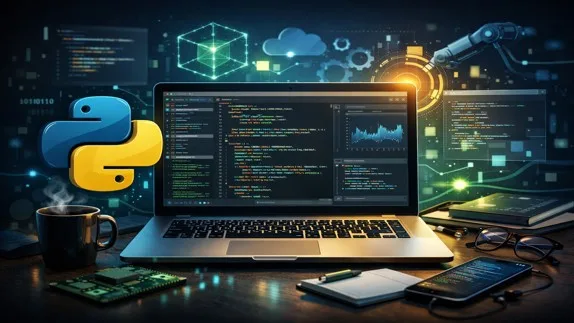
Learn Python from scratch: A simple yet powerful programming language. Discover how to start coding with Python and bring your ideas to life.
Python Programming
- 👨🏫 Author: mohammad saleh salmanzadeh
- 🌐 Language: Persian / English
- 📝 Creation Date:
- 📅 Last Updated Date:
- 📂 Category: Game Programming
- 🔗 Sharing:
Python Programming: Your Friendly Gateway to the World of Coding
Introduction: Why Python is the Perfect First Language
Welcome! Have you ever wondered how websites, apps, and games are built? Or how data gets analyzed to predict trends? Behind all of this magic lies a set of instructions called code, and learning to write it is learning to speak a new, powerful language. If you're thinking about learning to code but feel intimidated, you're in the right place. Meet Python – often called the world's most beginner-friendly programming language.
Imagine a programming language that reads almost like plain English, with a simple and clean structure. That's Python. It was created by Guido van Rossum in the late 1980s with a core philosophy: code should be easy to read and write. Today, Python has exploded in popularity, powering giants like Google, Instagram, Netflix, and NASA. From building websites and analyzing scientific data to creating artificial intelligence and automating boring tasks, Python is a versatile superstar. This article is your first step. We'll explore what makes Python special, its core concepts, and how you can start writing your own programs today. No prior experience required!
What is Python and Why Should You Learn It?
Python is a high-level, interpreted, and general-purpose programming language. Let's break down what that means:
High-level: It uses human-readable syntax (words and structures) that is far removed from the complex binary code (0s and 1s) computers actually understand. You write print("Hello!"), not a cryptic machine command.
Interpreted: You can run Python code line-by-line immediately, without needing to compile it into a separate file first. This makes testing and debugging much faster and easier for beginners.
General-purpose: It's not limited to one type of task. You can use it for almost anything.
The Key Advantages of Python
Simplicity and Readability: Python's syntax is clear and intuitive. It uses indentation (whitespace) to define blocks of code, which forces a clean, readable style. This reduces "syntax errors" that plague beginners in other languages.
Huge Community and Vast Resources: When you learn Python, you're never alone. It has one of the largest and most supportive communities online. For any problem you encounter, there are countless free tutorials, forums (like Stack Overflow), and documentation available.
Massive Ecosystem of Libraries: A library is a collection of pre-written code that you can use. Python's ecosystem, managed by the Python Package Index (PyPI), is immense.
Want data science? Use NumPy and Pandas.
Want machine learning? Use scikit-learn or TensorFlow.
Want to build a website? Use Django or Flask.
This means you don't have to build everything from scratch.
High Demand in the Job Market: Python skills are consistently among the most sought-after by employers across fields like software development, data analysis, DevOps, and cybersecurity.
Getting Started: Your First Python Program
The best way to learn is by doing. Let's set up your environment and write the traditional first program.
Step 1: Installation
Head to the official website, python.org, and download the latest version for your operating system (Windows, macOS, Linux). The installer includes IDLE, Python's basic built-in editor, which is perfect for starting.
Step 2: Writing "Hello, World!"
In programming, tradition dictates your first program should simply display "Hello, World!".
Open IDLE or any simple text editor (like Notepad++ or VS Code for a better experience).
Type the following line:
python
print("Hello, World!")
Save the file with a .py extension, for example, hello.py.
Run it! In IDLE, you can press F5. From your computer's terminal or command prompt, navigate to the file's location and type python hello.py.
Congratulations! You've just written and executed a Python script. The print() function is your tool for outputting text to the screen.
Example: Getting User Input
python
name = input("What is your name? ")
age = input("How old are you? ")

print("Hello " + name + "!")
print("You are " + age + " years old.")
Output:
text
What is your name? Alex
How old are you? 25
Hello Alex!
You are 25 years old.
Core Concepts of Python Programming
To build programs, you need to understand some fundamental building blocks.
Variables and Data Types: Storing Information
A variable is like a labeled box where you store data. In Python, you create one by simply giving it a name and assigning a value with the = sign.
python
name = "Alice"  # Text (String)
age = 30        # Whole number (Integer)
temperature = 98.6  # Decimal number (Float)
is_student = True   # Boolean (True or False)
Python automatically figures out the data type.
Control Flow: Making Decisions and Repeating Tasks
Programs need to make choices and do things repeatedly.
Conditional Statements (if, elif, else)
These let your code make decisions.
python
weather = "rainy"
if weather == "sunny":
    print("Wear sunglasses!")
elif weather == "rainy":
    print("Take an umbrella!")
else:
    print("Check the forecast!")
Loops (for, while)
Loops repeat actions.
for loop: Great for iterating over a sequence (like a list).
python
fruits = ["apple", "banana", "cherry"]
for fruit in fruits:    print(fruit)
while loop: Repeats as long as a condition is true.
python
count = 0
while count < 5:
    print(count)
    count = count + 1
Functions: Reusable Blocks of Code
A function is a named block of code that performs a specific task. It helps you avoid repetition.
python
def greet(person):
	message = "Hello, " + person + "!"
	return message
print(greet("Alice"))  # Output: Hello, Alice!
print(greet("Bob"))    # Output: Hello, Bob!
Here, def defines the function greet. person is a parameter (input), and return sends an output back.
Data Structures: Organizing Information
Python has built-in ways to organize data.
Lists: Ordered, changeable collections. my_list = [1, 2, 3]
Dictionaries: Collections of key-value pairs (like a real dictionary). my_dict = {"name": "Alice", "age": 30}
Tuples: Ordered, unchangeable collections. my_tuple = (1, 2, 3)
Python in Action: Real-World Applications
Python isn't just for exercises; it's a tool for solving real problems.
Web Development
Frameworks like Django and Flask let you build the backend (server-side logic) of websites quickly and securely. Instagram and Pinterest use Django.
Data Science & Machine Learning
Python is the undisputed king here. Libraries like Pandas (for data manipulation), Matplotlib (for visualization), and scikit-learn (for building ML models) make complex analysis accessible.
Automation and Scripting
Do you have repetitive computer tasks? Python can automate them! Renaming files, scraping web data, sending emails, or organizing folders—Python scripts can handle it, saving you hours.
Software Development
From desktop applications to game development (using libraries like Pygame), Python is a robust tool for building software.
Your Learning Roadmap and Resources
Ready to dive deeper? Here’s a suggested path and excellent free resources.
Step-by-Step Learning Path:
Basics: Variables, data types, basic I/O (like print and input).
Control Flow: Conditionals and loops.
Data Structures: Master lists, dictionaries, tuples, and sets.
Functions & Modules: Learn to write clean, reusable code and use Python's built-in modules.
Object-Oriented Programming (OOP): Understand classes and objects for more complex programs.
Specialize: Pick an area (Web Dev, Data Science, etc.) and learn its key libraries.
Top Free Resources:
Official Documentation (docs.python.org): The ultimate source.
Online Courses: Platforms like freeCodeCamp, Codecademy, and Coursera have excellent introductory Python courses.
Practice Platforms: HackerRank, LeetCode (Easy problems), and Edabit offer coding challenges.
Books: "Automate the Boring Stuff with Python" by Al Sweigart is a fantastic, practical beginner's book (free to read online).
Conclusion: Your Coding Journey Begins Here
Python is more than just a programming language; it's a passport to the digital world. Its gentle learning curve, combined with immense power and versatility, makes it the ideal starting point for anyone curious about technology, problem-solving, or creating with code. Remember, every expert programmer once wrote their first print("Hello, World!"). The key is consistent practice. Start small, be patient with yourself, and build progressively.
Don't just consume technology—start creating it. Set up Python, follow a tutorial, build a simple calculator, automate a task on your computer, or analyze a dataset that interests you. The community is vast and welcoming. Embrace the challenge, enjoy the puzzle-solving, and watch as you gain the superpower to instruct machines and bring your ideas to life. Your journey into the limitless world of programming starts now. What will you create first?
📚 Related content:
- Programming with Artificial Intelligence: A Beginner’s Guide
- An Introduction to Programming for Beginners
- Programming for Kids: A Simple Guide to Teaching Children How to Code
- Learning Game Programming from Scratch: A Beginner-Friendly Guide
- Android Programming for Beginners: A Complete and Simple Guide
- C# Game Programming: A Beginner’s Guide to Building Games with Confidence
Q1: What is Python and why is it suitable for beginners?
Answer: Python is a high-level, interpreted, general-purpose programming language designed with a simple and readable syntax, resembling plain English. Created by Guido van Rossum, it's now used by tech giants like Google, Instagram, Netflix, and NASA. Python is the best choice for beginners due to its simplicity, large community, and extensive learning resources.
Q2: What can you build with Python?
Answer: Python is a versatile language with wide applications, including: web development (with Django and Flask), data science and machine learning (with NumPy, Pandas, scikit-learn, and TensorFlow), task automation, desktop software development, game development (with Pygame), data analysis, scripting, and even cybersecurity. This versatility makes Python one of the most widely used languages in the world.
Q3: Do I need programming experience to learn Python?
Answer: No. Python is specifically designed for people with no programming background. Its simple, English-like syntax reduces the fear of coding, allowing you to write and run real code from the very first session. Many universities and educational programs use Python as their first programming language.
Q4: What tools do I need to start programming with Python?
Answer: To start, you only need to install the latest version of Python from python.org. This includes IDLE (a simple editor) which is sufficient for writing and running basic code. Later, you can use more professional editors like Visual Studio Code, PyCharm, or Notepad++. All these tools are free.
Q5: How long does it take to learn Python and what is the learning path?
Answer: With regular practice, learning the basics (variables, conditionals, loops, functions, and data structures) typically takes 1 to 2 months. Achieving relative proficiency for real-world projects and specializing in areas like web or data science requires about 3 to 6 months of consistent practice. The recommended path includes: (1) fundamentals, (2) control flow, (3) data structures, (4) functions and modules, (5) object-oriented programming, and then (6) specializing in a specific field.
Q6: Is Python valuable in the job market and what are the career opportunities?
Answer: Yes, Python is one of the most in-demand skills in various fields. Career opportunities include web developer (backend), data scientist, machine learning engineer, data analyst, software developer, cybersecurity specialist, and process automation. Large companies and startups are constantly seeking Python programmers, making it one of the best choices for starting a successful career in technology.
- 🗨️ No comments have been posted for this article yet. Be the first!