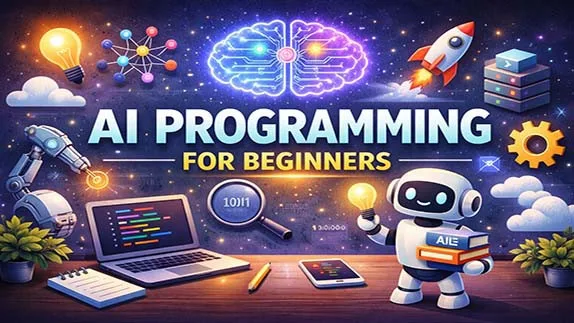
Learn AI programming from scratch with this beginner-friendly guide, explained in simple language with no technical background required.
Artificial Intelligence Programming for Beginners: A Simple and Complete Guide
- 👨🏫 Author: mohammad saleh salmanzadeh
- 🌐 Language: Persian / English
- 📝 Creation Date:
- 📅 Last Updated Date:
- 📂 Category: Game Programming
- 🔗 Sharing:

Artificial Intelligence Programming for Beginners: A Simple and Complete Guide
Introduction
Artificial Intelligence (AI) is no longer science fiction. It is already part of our daily lives. From voice assistants like Siri and Alexa to recommendation systems on YouTube and Netflix, AI is everywhere.
Many people want to learn AI programming, but they believe it is too complex or requires advanced math and deep technical knowledge. This belief is wrong.
This article is written for absolute beginners. You do not need any background in programming, mathematics, or computer science. Everything is explained in a simple, clear, and educational way.
By the end of this guide, you will:
Understand what Artificial Intelligence really is
Learn how AI programming works
Know which tools and languages to start with
Understand the learning path to become an AI programmer
What Is Artificial Intelligence? (Simple Explanation)
Artificial Intelligence is the ability of a computer or software to think, learn, and make decisions similar to a human.
In simple terms:
AI allows machines to learn from data and improve their performance over time.
AI systems do not “think” like humans, but they can:
Recognize patterns
Analyze data
Make predictions
Solve problems
Examples of Artificial Intelligence in Real Life
AI is already around you, even if you don’t notice it.
Common AI Examples
Google search results
Face recognition on smartphones
Chatbots and virtual assistants
Spam email filtering
Online product recommendations
Self-driving car features
These systems are powered by AI programming.
What Is AI Programming?
AI programming is the process of writing code that allows machines to learn and make decisions.
Unlike traditional programming, where you write exact rules, AI programming often works like this:
You give the computer data
You teach it how to learn from the data
The computer finds patterns by itself
It makes predictions or decisions
Do You Need to Be a Math Genius to Learn AI?
No. This is one of the biggest myths.
For beginners:
You do NOT need advanced math
You do NOT need to be a programmer already
You only need basic logic and patience
Math becomes important later, but you can start AI programming without it.
Main Types of Artificial Intelligence
1. Narrow AI
This is the most common type of AI today.
Performs one specific task
Cannot think outside its task
Examples:
Image recognition
Language translation
Recommendation systems
2. General AI (Theoretical)
Can think like a human
Does not exist yet
As a beginner, you will work only with Narrow AI.
Key Areas of AI Programming
Machine Learning
Machine Learning allows computers to learn from data.
Example:
Predicting house prices
Email spam detection
Deep Learning
A more advanced form of Machine Learning inspired by the human brain.
Example:
Image recognition
Voice recognition
Natural Language Processing (NLP)
Helps computers understand human language.
Example:
Chatbots
Translation tools
Computer Vision
Allows computers to understand images and videos.
Example:
Face recognition
Medical image analysis
Best Programming Language for AI Beginners
Python (Best Choice)
Python is the most popular language for AI programming.
Why Python?
Simple and readable
Huge AI libraries
Strong community support
Beginner-friendly
Other languages exist, but Python is the best starting point.
Basic Tools Used in AI Programming
Python Libraries
NumPy → numerical operations
Pandas → data analysis
Matplotlib → data visualization
Scikit-learn → machine learning
TensorFlow / PyTorch → deep learning
You don’t need to learn all of them at once.
How AI Learns: A Simple Concept
AI learns using data.
Example:
You show an AI thousands of pictures of cats and dogs
You tell it which is which
The AI learns patterns
Later, it can identify new images by itself
This process is called training.
Types of Machine Learning
1. Supervised Learning
Data has labels
AI learns from examples
Example:
Email labeled as spam or not spam
2. Unsupervised Learning
Data has no labels
AI finds patterns by itself
Example:
Customer segmentation
3. Reinforcement Learning
AI learns through rewards and penalties
Example:
Game-playing AI
A Simple AI Programming Example (Conceptual)
Imagine you want to predict whether a student will pass an exam.
You give the AI:
Study hours
Attendance
Past scores
The AI learns from previous students and predicts outcomes for new students.
This is AI programming in action.
Example: Simple Prediction with Scikit-learn
# Simple example: House price prediction based on size (sqm)
from sklearn.linear_model import LinearRegression

# Training data (size sqm, price)
X = [[50], [60], [70], [80], [90]]  # Size in square meters
y = [200, 240, 280, 320, 360]       # Price in million tomans

# Build the model
model = LinearRegression()
model.fit(X, y)

# Predict for a 100 sqm house
prediction = model.predict([[100]])
print(f"Estimated price for 100 sqm house: {prediction[0]} million tomans")
Explanation: The model learns the relationship between size and price, then predicts for a new house.
Step-by-Step Learning Path for Beginners
Step 1: Learn Basic Programming
Variables
Conditions
Loops
Functions
Step 2: Learn Python Basics
Writing simple scripts
Working with data
Step 3: Understand Data
What data is
How to clean data
How to analyze data
Step 4: Learn Machine Learning Basics
Simple models
Training and testing
Step 5: Build Small Projects
Spam detector
Price prediction
Simple chatbot
Common Beginner Mistakes in AI Learning
Trying to learn everything at once
Skipping fundamentals
Watching tutorials without practice
Expecting fast results
Giving up too early
AI is a long-term skill, not a shortcut.
How to Practice AI Programming Effectively
Build small projects
Use real datasets
Experiment and make mistakes
Read explanations, not just code
Focus on understanding, not memorizing
Career Opportunities in AI Programming
AI skills are in high demand.
Popular AI Roles
AI Developer
Machine Learning Engineer
Data Scientist
AI Research Assistant
AI is used in:
Healthcare
Finance
Education
Marketing
Technology
Is AI Programming Hard? (Honest Answer)
AI programming is:
Challenging but learnable
Complex but logical
Difficult without practice
Powerful with persistence
It is not impossible and not reserved for geniuses.
Future of Artificial Intelligence
AI will continue to grow and impact:
Jobs
Businesses
Daily life
Education
Learning AI today is an investment in the future.
Conclusion
Artificial Intelligence programming is one of the most valuable skills of the modern world. You do not need a technical background to start. With simple explanations, the right tools, and consistent practice, anyone can learn AI programming.
The most important rule is simple:
Start small, stay consistent, and keep learning.
AI is not about intelligence.
It is about curiosity and persistence.
📚 Related content:
- Programming for Kids: A Simple Guide to Teaching Children How to Code
- Learning Game Programming from Scratch: A Beginner-Friendly Guide
- Android Programming for Beginners: A Complete and Simple Guide
- C# Game Programming: A Beginner’s Guide to Building Games with Confidence
Q1: What is Artificial Intelligence?
Answer: Artificial Intelligence (AI) is the ability of a system or software to learn, analyze, and make decisions similar to humans. In simple terms, AI allows machines to learn from data and improve over time. AI systems recognize patterns, analyze data, make predictions, and solve problems.
Q2: Do I need advanced math to learn AI programming?
Answer: No. This is one of the biggest misconceptions. To start, you don't need advanced math or specialized knowledge. Basic logic and practice are enough. Math becomes important at more advanced levels, but for learning fundamentals and building simple projects, it's not necessary.
Q3: What is the best programming language for starting AI?
Answer: Python is the best choice for beginners. Python is simple, readable, and close to human language. It has powerful libraries like NumPy, Pandas, Scikit-learn, and TensorFlow that make working with data and building AI models very easy. Python's large community is also a great learning resource.
Q4: What is the difference between AI, Machine Learning, and Deep Learning?
Answer: Artificial Intelligence (AI) is a broad field that includes any system that exhibits intelligent behavior. Machine Learning (ML) is a subset of AI where systems learn from data. Deep Learning (DL) is a subset of ML that uses deep neural networks inspired by the human brain and is used for more complex tasks like image and speech recognition.
Q5: What is the learning path for AI programming for beginners?
Answer: The recommended path includes: (1) learning basic programming concepts like variables, conditionals, loops, and functions, (2) learning Python and working with data, (3) understanding data concepts and analysis, (4) learning basic machine learning concepts and simple models, and (5) building small projects like spam detection, price prediction, or simple chatbots. Hands-on practice and project-based learning are key to progress.
Q6: Is learning AI difficult and how long does it take?
Answer: AI is challenging, but definitely learnable. With regular practice, understanding fundamentals and building simple projects typically takes 3 to 6 months. Reaching a professional level requires 1 to 2 years of consistent practice and working on real-world projects. The important thing is that genius is not required—persistence and consistent practice are the most important factors for success.
- 🗨️ No comments have been posted for this article yet. Be the first!